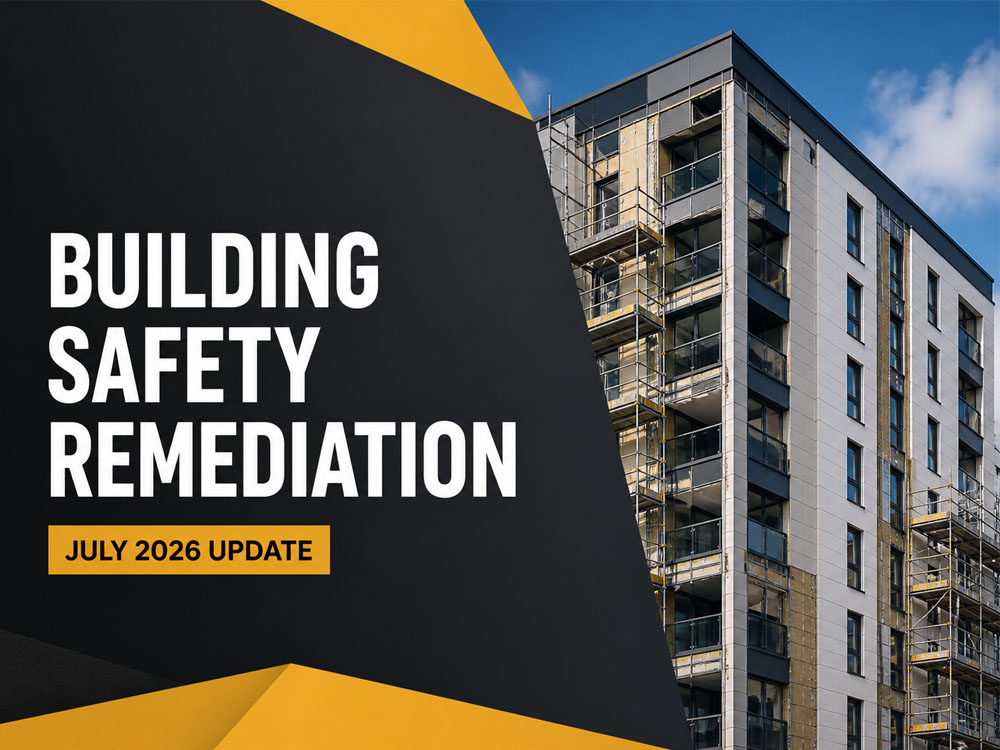
Government figures reveal continued progress in removing unsafe cladding, while highlighting the scale of remediation work still to be delivered across England.
The latest government figures show continued progress in addressing unsafe cladding across residential buildings in England—but also highlight the considerable amount of remediation work still to be delivered.
The Ministry of Housing, Communities and Local Government’s July 2026 data release covers residential buildings measuring 11 metres and over whose remediation progress is being monitored through government programmes, developer-led commitments and social housing providers.
More Buildings Identified and Monitored
At the end of July 2026, 4,697 residential buildings measuring 11 metres and over had been identified with unsafe cladding and were being monitored. This represents an increase of 228 buildings since the end of June.
The increase largely reflects the inclusion of more social housing buildings within the reported data. Changes in the number of buildings being monitored should therefore be considered alongside updates to data collection and reporting.
Of the 4,697 identified buildings:
- 1,833 buildings—39%—had completed remediation
- 718 buildings—15%—had remediation work underway
- 2,146 buildings—46%—had not started remediation
Overall, 54% of the buildings being monitored had either started or completed remediation by the end of July.
Progress Across Remediation Programmes
The figures indicate different rates of progress across the principal remediation programmes.
Within the ACM programme, 478 of the 516 identified high-rise buildings had completed remediation, including buildings awaiting building control sign-off. A further 24 had started work, meaning 97% had either started or completed remediation.
The Building Safety Fund reported that 487 of its 639 eligible high-rise buildings had completed remediation. In total, 562 buildings—88% of those proceeding through the fund—had started or completed work.
Progress within the Cladding Safety Scheme remains at an earlier stage. Of the 1,438 buildings assessed as eligible, 396 had started or completed remediation and 127 had completed work. A further 2,253 buildings remained within pre-eligible stages of the scheme.
What the Figures Mean for the Industry
The latest data demonstrates that meaningful progress is being made. It also shows the continuing need for building owners, developers, consultants and contractors to move projects from assessment and planning into physical remediation.
Successful external wall remediation requires more than replacing cladding panels. Intrusive surveys, detailed design, material specification, installation planning and careful coordination must work together to produce safe, compliant and buildable solutions.
Early engagement between clients, consultants and specialist façade contractors can help identify technical requirements, clarify the proposed scope and support effective project delivery.
Supporting Safer, Compliant Buildings
Simbi Ltd provides specialist façade and external wall remediation services across London and the South East. Our capabilities include intrusive survey facilitation, Stage 5 design, the removal of non-compliant façade materials, and the supply and installation of specified compliant systems.
We work collaboratively with clients, consultants and architects to develop practical solutions that respond to the requirements of each building.
If you are planning an external wall remediation or cladding replacement project, contact Simbi Ltd to discuss your building and project requirements.
Source: Building Safety Remediation: monthly data release – July 2026, Ministry of Housing, Communities and Local Government, published 26 August 2026.
about
Simbi Ltd
Specialist façade and cladding contractors delivering design, remediation and installation services across London and the South East.